
In 2024, customers noticed that Instacart was charging different prices to different people for the same groceries. The internet erupted. Price discrimination. Gouging. Algorithmic exploitation. Instacart scrambled to explain. Nobody cared.
But here’s the part worth noticing: the algorithm hadn’t changed. What changed was that people knew about it. Customers who discovered dynamic pricing started timing their orders differently, comparing prices across platforms, switching to competitors. The behavior the algorithm was trained on—years of purchasing patterns from people who didn’t know the price was adjustable—was no longer the behavior it was facing. The model was optimized for a world that stopped existing the moment the model became visible.
This isn’t a bug in Instacart’s pricing algorithm. It’s a fundamental property of any system that tries to set prices for participants who can react to them. The moment the outputs become known, the inputs shift.
Zillow learned this expensively in 2021, when it tried to buy homes with an algorithm. The Zestimate generated an offer; the homeowner decided whether to accept. But the homeowner knew things the algorithm didn’t—the outdated kitchen, the noisy neighbors, the pending assessment. Owners whose homes were worth more than the offer sold on the open market. Owners whose homes were worth less sold to Zillow. The algorithm’s errors were random, but the market’s choices weren’t. They were systematically harvested by sellers who had their own opinion of what the home was worth, regardless of what their “Zestimate” said. Zillow wrote down $528 million in a single quarter and shut the program down.
Why It Feels Like It Should Work
Netflix knows what you want to watch before you do. Spotify builds playlists that feel like they were curated by a friend who’s known you for years. Amazon has your package pre-staged at a local warehouse before you’ve clicked “buy.” The experience of living inside these systems is the experience of being known—predicted, anticipated, served. Every year the predictions get better. Every year the algorithms learn more. The intuition writes itself: given enough data and enough compute, you could do this for everything.
And for most of what these systems do, the intuition is correct. Recommending a song costs nothing if it’s wrong, you just hit “skip.” Suggesting a new route to a driver costs one notification. Preloading a warehouse costs shelf space for inventory that needs to be stored somewhere anyway. The stakes are low, the feedback is fast, and the person on the other end mostly doesn’t know or care how the prediction was generated. Spotify doesn’t need to understand why you wanted that song at 2 AM. It just needs to know that people who listened to the last four songs you played tend to listen to this one next. Pattern matching. It’s what neural networks were born to do.
But an economy isn’t a playlist.
The Oldest New Idea
In 1920, Ludwig von Mises published “Economic Calculation in the Socialist Commonwealth.” The standard reading—then and now—is that central planning fails because the planner can’t gather enough information. Millions of producers, consumers, preferences, constraints—no bureaucracy can collect and process it all. The market distributes the computation across every participant, with prices as the output. It’s an information-processing problem, and the market is the best available computer.
This reading is tidy, intuitive, and wrong.
The Soviets built Gosplan—a planning agency that set prices and production targets for everything the economy produced, from steel and tractors to toothbrushes and children’s shoes. Five-year plans. How many tons of pig iron, how many combines, how many meters of cotton fabric. And they could get the data. They had the census reports, the factory output logs, the agricultural surveys. Analysts in Moscow could tell you what came out of Magnitogorsk last quarter down to the metric ton. The data was real. The problem was processing it—coordinating millions of moving parts with pencils, telegrams, and a bureaucratic apparatus that moved at the speed of government. Presumably, given better technology, the problem shrinks. Given AI, maybe it disappears altogether.
Most of Mises’ readers—even sympathetic ones—took him literally: the market is a better computer than a bureaucracy. Hayek, a generation later, took him seriously. Hayek noticed that the information the planner needs isn’t the information Gosplan was collecting. A market doesn’t just need to know how much wheat there is. It needs to know how much wheat is worth—to a specific person, at a specific moment, who could also buy rice, or corn, or skip the purchase entirely because she heard flour might be cheaper next month. That’s not a fact waiting to be collected. It’s a fact that doesn’t exist until after someone decides it for herself.
What the Algorithm Would Need
Gosplan could count the wheat. Any sufficiently powerful computer can count the wheat. Wheat supply is a fact about the world—it sits in silos and on loading docks and can be measured. But price isn’t supply. Price is supply and demand. And demand doesn’t sit anywhere.
Walk onto a car lot. You came to look at the truck. The color’s not great in person. You reconsider. The sedan catches your eye—the trunk is bigger than you thought. Actually, maybe the truck’s not so bad after all. Your preferences aren’t a fixed quantity waiting to be measured—they’re generated in the interaction, shaped by the prices, the alternatives, the salesperson, your morning, your mood, and a hundred variables that didn’t stabilize into a decision until the moment you either signed or walked away.
The market didn’t read that preference. It produced it. The act of deciding generated information that didn’t exist until the decision was made. The transaction is the information—and not just for cars. How much demand is there for an invention that won’t be invented until next year? The question doesn’t have an answer. Not because the answer is hard to find, but because it doesn’t exist yet.
This is why nobody bets on gravity, or at least, nobody bets against it. It’s too predictable—there’s nothing to wager on. But people bet on sports all the time, billions of dollars a year, because human performance is irreducibly unpredictable until it happens. The models help at the margins. They can calculate the odds. But nobody knows what a specific person does in a specific moment until they’re in it and they do it. The odds are probabilities. The outcome is binary. Either they scored, or they didn’t.
An economy is eight billion people in that moment simultaneously, each decision shifting the conditions for every subsequent one. The algorithm needs next week’s answers to generate this week’s prices. The market generates this week’s prices and lets next week take care of itself.
Why Compute Doesn’t Help
A climate model can be wrong about ocean temperatures in 2040 and it doesn’t matter to the ocean. The ocean doesn’t read the forecast.
An economic model that predicts bread will cost $4 next month changes the behavior of every baker and buyer the moment the prediction is published. Buyers stock up at $3.50, creating a demand spike that pushes the price to $4.25. Bakers overproduce in anticipation of a windfall. The price crashes to $2.75. The prediction was wrong because it was right. The model’s output became an input to the system it was modeling.
This is how grocery shelves go bare the night before a snowstorm. Not because there isn’t enough bread—because the expectation that there won’t be enough bread produces exactly the shortage it predicted. The algorithm doesn’t sit outside the economy and observe it. It lands inside and changes everything it touches.
Google Maps runs into this at 5 PM every weekday. Route everyone around the traffic jam on the freeway and the side streets become the jam. Google’s solution isn’t a better prediction—it’s a deliberately worse route. The algorithm serves individual drivers suboptimal paths so that the system clears. It solved the problem by reinventing the mechanism a market already uses: give everyone slightly different information, so they each make slightly different choices.
And even that only holds while drivers trust the algorithm more than their own eyes. The moment you suspect Google is giving you a worse route, you stop following it. You take the turn that looks faster. The car behind you does the same. And now the algorithm is optimizing for a road full of people who all think they know a shortcut.
The Strongest Test
AI is the strongest possible version of the argument Mises already defeated. Not a bureaucrat with a clipboard—a near-omniscient intelligence with access to more data than any human institution has ever processed. If managing global production were really about processing speed or information access, this would be the answer.
It isn’t. The observer—however powerful, however fast—is still an observer. It can read the market’s outputs but not generate them, because the information only exists when real people make real decisions at real prices. An AI that enters the market doesn’t replace it—it joins it. Amazon’s pre-positioning, Uber’s surge pricing, Spotify’s recommendations—these are the best-equipped market participants in the history of commerce. But they’re only participants. A faster car doesn’t replace traffic.1
Every generation produces a new version of this confidence. The Soviets thought central planning would outperform markets because they had the right theory of what people needed. The techno-optimists think AI will outperform markets because they have better data on what people do. Same error, better hardware.
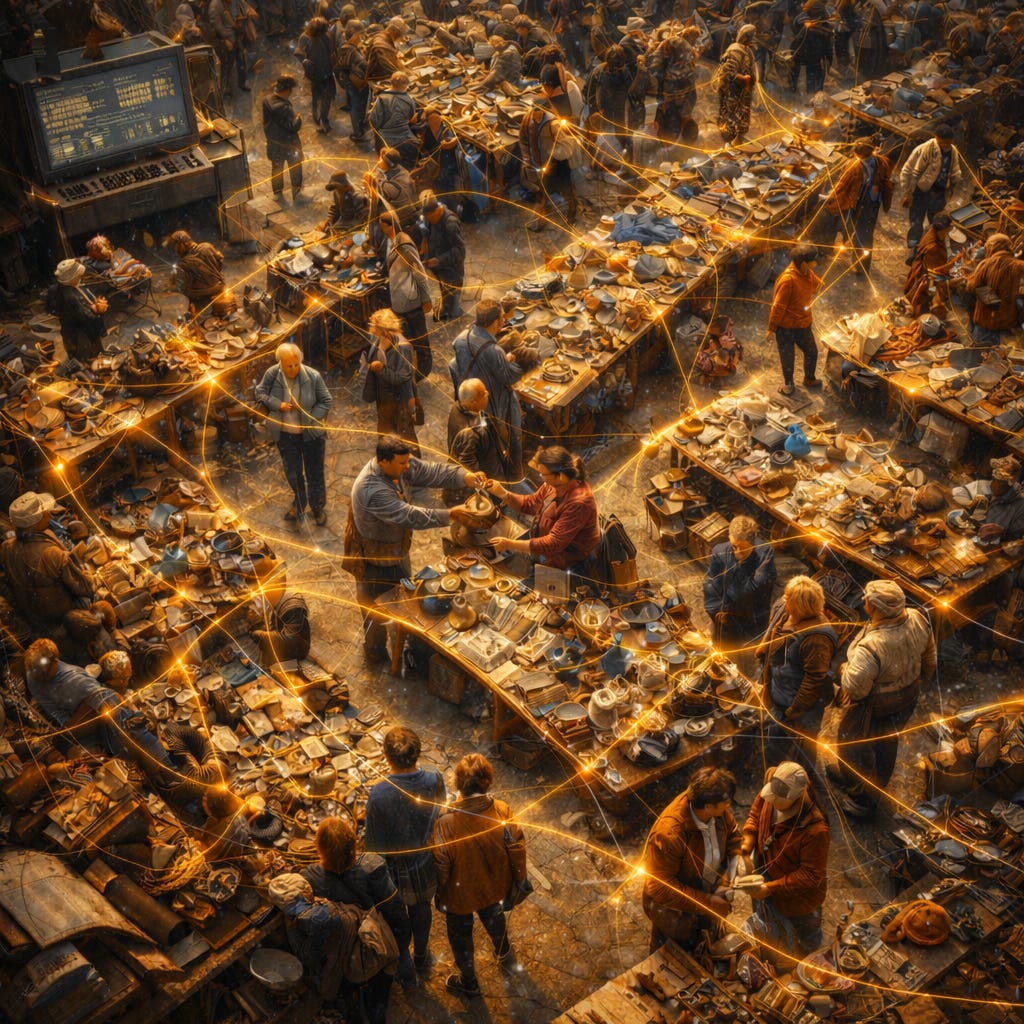
Mises argued against central planners with pencils. He was right—and not because pencils are slow. The strongest technology ever built hits the same wall: you cannot allocate resources better than a market, because the market is generating the information you’d need to beat it. An economy isn’t a system to be solved. It’s a process that generates solutions—continuously, locally, and destructively, overwriting the last answer with the next transaction. The most powerful computer ever built can read the flea market’s prices. It cannot generate them. That takes a Saturday morning and two people willing to haggle over a lamp.
You’re not in traffic. You are traffic.