
According to the latest outrage cycle, we’re supposed to be upset about Trump strong-arming the otherwise independent Federal Reserve. In this episode, Jerome Powell is the cool and collected crisis negotiator, stoically leading us through Trump’s tweet-threats about lowering interest rates, with Trump playing the hostage taker demanding an escape helicopter that he doesn’t know how to fly.
The establishment narrative is predictable: an unelected central bank must remain free from political pressure to maintain credibility and prevent monetary chaos. Long live the Technocrats. The populist response is equally cliché: unelected bureaucrats shouldn’t control the economy; elected officials should set policy that helps workers, not Wall Street.
Performative messaging that’s more aligned than either would admit. Neither is asking the question that actually matters: why is the price of money set by a Politburo committee vote at all?
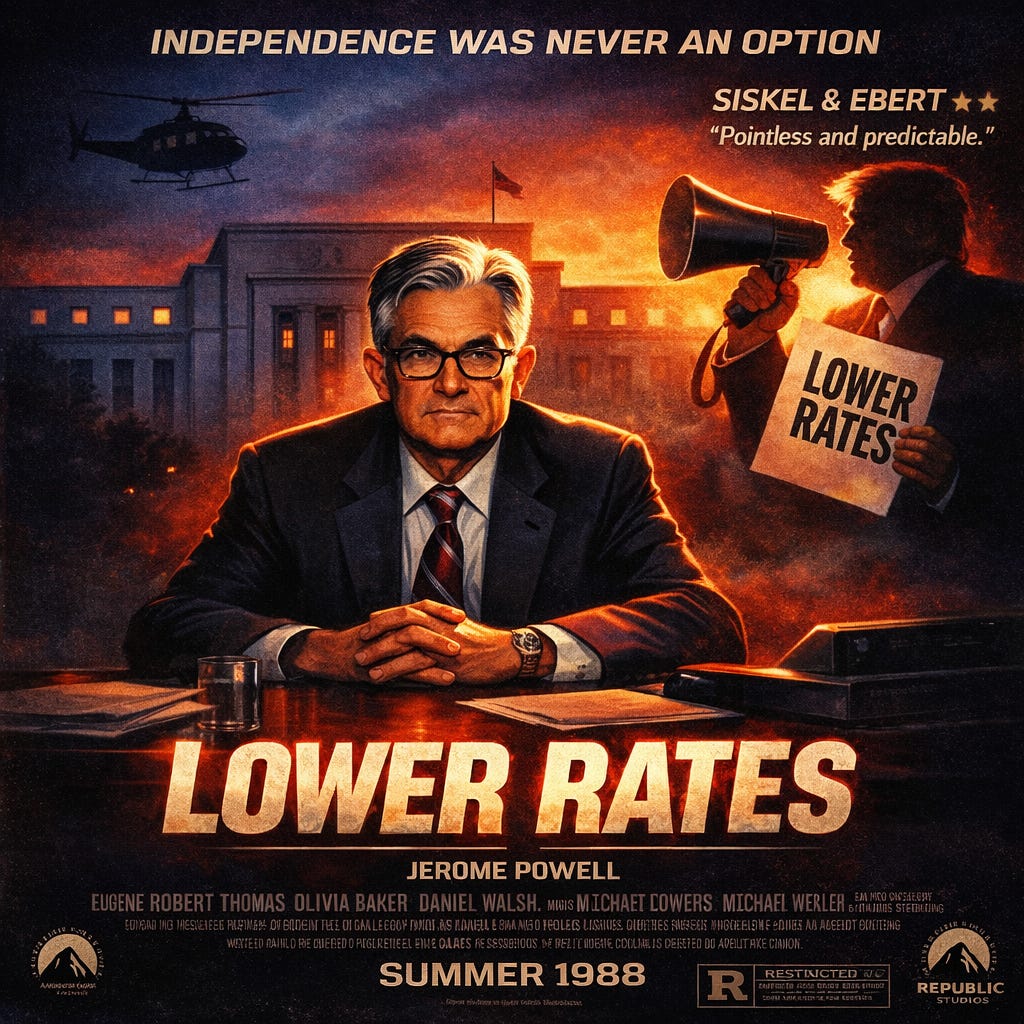
The Independence That Never Was
If you need evidence that Fed independence is theater, you don’t need to speculate about smoke-filled rooms or scry the FOMC minutes. You can just listen to the tapes. August 1971. Richard Nixon is facing reelection with inflation rising and growth slowing. He calls Fed Chairman Arthur Burns to Camp David. We have the recordings. Nixon isn’t subtle: “We’ll take care of you if you help us out.” Burns, according to his own diary entries published years later, knew exactly what was being asked. He understood that accommodative monetary policy would help Nixon’s campaign, at the cost of fueling significant inflation. In any conventional sense, the economic alarm signals were already blaring. He lowered rates anyway.
The Fed maintained this politically accommodative posture through 1972. Nixon won his reelection in a landslide. Inflation hit 11% by 1974, rivaling even the “transitory” Bidenomics. This isn’t ancient history or partisan conspiracy theory. These are Burns’s own words, recorded in real time, published after his death. The independence was fiction all along. The political influence was explicit.
But here’s what makes the Burns example so devastating: he’s retroactively cited as a cautionary tale about maintaining Fed independence; a warning about what happens when central bankers bend to political pressure. The lesson supposedly learned was that we needed more independence, stronger protections, better institutional safeguards.
Then came Paul Volcker, the supposed hero of Fed independence and the administrative-state wing of the left. Carter appointed him in 1979 with explicit instructions to break inflation. Volcker delivered—raising rates to 20% in the process, triggering a brutal recession, and accepting the political blame.
Then Reagan kept him in the role. Not because he couldn’t be removed, but because he couldn’t be promoted any further. You don’t dismiss the guy taking the heat for the painful medicine the economy needed. Volcker’s “independence” was actually perfect cover for pure bipartisan alignment: both administrations wanted the same outcome, they just preferred for the Fed to absorb the political cost. If these are examples of Fed independence—one where the chairman admits in his diary he caved to pressure, and another where “independence” meant doing exactly what both parties wanted—then independence has never existed. Which, of course, it hasn’t. The current outrage over Trump and Powell isn’t about some sacred norm being violated. It’s about whose team gets to run the machinery.
The Counter-Cyclical Con
The entire justification for central bank intervention rests on an argument for counter-cyclical policy: markets panic, the Fed steps in as the lender of last resort, stability returns, crisis averted. It’s the adult supervision theory of monetary policy—that markets are emotional children who need timeouts during tantrums.
But, if this theory is accurate, the Fed shouldn’t be printing money with presses, they should be printing money with trades. They’re buying assets when everyone else is panicking—stepping in as a price floor, definitionally at the bottom. They’re selling, or allowing their balance sheet to contract, when markets stabilize—exiting near the top to curtail irrational exuberance. They have perfect timing by design. Every crisis becomes an opportunity to buy low. Every recovery becomes an opportunity to sell high. If counter-cyclical intervention is stabilizing rather than distorting, profits aren’t the objective—but they should still be the inevitable side effect.
So where are the returns?
The Fed’s balance sheet expanded from under $1 trillion before 2008 to over $9 trillion at its peak. Some of this expansion fits the counter-cyclical story: nearly $2T in mortgage-backed securities bought during the 2008 panic, at fire-sale prices when liquidity had vanished. When markets normalized and default risk evaporated, those positions should have generated spectacular returns.
Instead, the Fed remits roughly $100 billion to Treasury in good years and currently operates at similar levels of loss. How? Because alongside those crisis purchases, they bought $6T in treasuries during QE programs—not during panics, but during expansions when yields were already near-zero. They paid peak prices for bonds during boom times. When Biden-era inflation pushed rates to high-single digits, those bonds crashed in value.
Counter-cyclical intervention means buying the panic and selling the recovery. The Fed bought the panic once, then bought the boom repeatedly, and held everything through the next crash.
The Fed has unlimited capital, perfect timing, zero competition, and gets to set the interest rates for the entire market, all while presumably buying bottoms and allegedly selling tops. They should be generating returns that make every hedge fund manager green with envy; profits which should flow back to Treasury. Instead they’re underperforming your savings account.
Adult supervision? This is a bottle of bourbon and a book of matches.
Three possibilities explain this, and none are reassuring.
If the Fed were genuinely stabilizing markets—buying during panics, unwinding into strength—profits would be the natural byproduct. More importantly, those exits would be deflationary: pulling liquidity out when the economy can absorb it, remitting gains to Treasury, shrinking the money supply during recoveries. That’s what “counter-cyclical” actually means. But the balance sheet only ratchets upward. They buy during crises and buy again during recoveries. The unwind never comes.
So either they’re incompetent—genuinely trying to stabilize but failing despite unlimited capital and perfect timing. Or they’re not trying to stabilize at all—they’re subsidizing—preventing price discovery, backstopping bad bets so connected institutions never face consequences for their failures, and socializing the losses through inflation. Or the simplest explanation: they were never independent in the first place. The Fed isn’t stabilizing markets; it’s financing government deficits that no one will vote to fund honestly, and intervening in private markets in whatever way is politically expedient.
Pick whichever you find least disturbing. All three arrive at the same place: what we call Fed open market activities are the systematic transfer of purchasing power from people who earn wages to people who own assets—and to a government that long ago gave up on using taxes as a budget for what it spends.
How Markets Actually Set Prices
In reality, the federal funds rate isn’t a policy tool. It’s a price control. We just use fancier language because admitting we’re running Soviet-style central planning for the most important price in capitalism would be embarrassing.
Interest rates set in an actual market—without a committee—work differently. When capital is scarce, borrowers compete for funds. Suppose there are 100 profitable projects requiring $10 million each, but only $500 million in available savings. Borrowers have to outbid each other, offering higher returns to attract the limited capital. Interest rates rise to, say, 12%. This high rate does two things: it attracts more savings (people defer consumption when returns are attractive) and eliminates marginal projects (only the most profitable ventures can justify 12% borrowing costs). Eventually, more savings arrive and less-profitable projects drop out until supply and demand balance—maybe at $700 million in available capital and 70 funded projects.
When capital is abundant, the dynamic reverses. Few profitable projects, lots of available savings. Lenders compete to deploy funds, offering lower and lower rates to attract borrowers that meet even minimal standards. Interest rates fall to, say, 3%. This encourages more borrowing (projects that couldn’t justify 12% suddenly pencil at 3%) and discourages excessive saving (why defer consumption for 3% returns?). The system self-corrects until supply and demand equilibrate.
The Fed short-circuits this entire mechanism. When they hold rates at zero during a boom, they’re telling savers “your capital isn’t wanted” while telling borrowers “borrow freely.” Both signals are false and distortionary. Capital is wanted—there are profitable projects—but savers can’t earn returns that justify deferring consumption. Meanwhile, borrowers fund projects that only work at artificial rates, which fail spectacularly when rates eventually normalize.
When the government controls bread prices, we get bread lines. When it controls labor prices, we get unemployment. When it controls the price of capital itself, we get exactly what we have: permanent financial instability masked as professional management.
The Cost of Money
You might be thinking this is an abstract debate about institutional design. It’s not. The Fed’s political capture creates specific, predictable distortions that show up everywhere you look.
When the Fed holds interest rates below the real market rates to help the Treasury service its debt, several things happen simultaneously—not as side effects, but as necessary mathematical consequences of suppressing the price of capital.
First, asset prices inflate. When borrowing costs 2% but productive investments return 6%, the gap gets arbitraged instantly. Investors borrow cheap money to buy anything that generates returns—stocks, real estate, commodities. We get an “everything bubble”. Asset owners see their net worth inflate automatically through this artificially generated buying demand. Their houses appreciate. Their portfolios grow.
Meanwhile, wage growth stays anchored to the supply and demand of real labor. Your salary increases with your productive output relative to the market, not with monetary expansion. The result is a growing gap between asset prices and incomes—one of the fundamental reasons 30-year-olds can’t afford the homes their parents bought at the same age. It’s not that houses got better or more scarce. It’s that asset prices inflated faster than the wages needed to buy them.
This creates the second-order effects you experience as permanent financial anxiety: Saving feels pointless when your “high-yield” account pays 3% while real assets inflate at 6-10% and you lose 4% to inflation. You’re getting poorer by being responsible. Homeownership becomes impossible when down payments require a decade of saving but prices rise 5% annually—you’re perpetually behind. Starting a family becomes a luxury good when housing costs are tied to inflated asset prices rather than wages.
The twenty-two-year-old starting her first job looks at this math and makes a perfectly rational decision: why save? The interest earned won’t keep pace with the asset inflation she’s trying to catch. Why have kids? She can’t afford housing stable enough to raise them in. She’s not being irresponsible or entitled. And she hasn’t suddenly reengineered a million years of evolutionary hardwiring. She’s responding rationally to the market signals being artificially broadcast by the Fed: the market doesn’t need your savings, it needs your spending.
This is why fertility rates are collapsing, why multigenerational households are returning, why Social Security faces insolvency as the wage base shrinks relative to obligations. Why more and more Americans are dependent on entitlement programs and state assistance, while the stock market is at all time highs. These aren’t separate problems requiring separate solutions. They’re all downstream consequences of the same cause: systematic suppression of politically driven interest rates, rather than market-discovered ones.
When you manipulate the price of capital—the foundational price on which every other economic decision rests—you don’t get isolated effects. You get cascading distortions that reshape the entire economy. The Fed’s political capture isn’t an abstract governance concern. It’s the mechanism converting your productivity into someone else’s asset appreciation while you pay higher grocery bills and wonder why you can’t get ahead.
And the worst part: the system isn’t broken. It’s working exactly as designed—it just wasn’t designed for you.
Exit Through the Gift Shop
The outrage over Trump and the Fed is cosplay. Both sides want the institution—they just want their team to run it. Democrats want technocratic PhD economists who read Bloomberg. Republicans want business-savvy appointees who read the Wall Street Journal. Neither wants to acknowledge that the political capture isn’t a bug—it’s what happens when you concentrate control over the most important price in the economy into a single, politically-appointed committee.
But here’s the thing: you should want the institution too. The Fed’s defenders have a coherent story. Markets panic. Liquidity freezes. A lender of last resort steps in, buys assets no one else will touch, injects liquidity, prevents contagion, and sells once calm returns. It’s not a crazy theory. Private market makers do exactly this and turn a profit. The function is legitimate.
So let’s take them at their word. If the Fed is genuinely providing independent, counter-cyclical stability—buying when markets are irrationally depressed and selling when they recover—there’s a simple way to prove it: show us the returns.
An institutional stabilizer buying genuinely undervalued assets during real market dysfunction would generate profits that no private investor could hope to match. Buy low, sell high, remit the gains to Treasury, repeat. That’s the model. That’s what “lender of last resort” should look like on a balance sheet.
Instead, we get billions in losses and a “deferred asset” that’s really just an IOU from future inflation. We get a Fed that bought trillions in MBS at crisis prices, watched default rates come in far below panic pricing, and somehow can’t turn a profit. We get an institution that sets both the rate it earns and the rate it pays—and still loses money.
The math doesn’t lie. If you’re buying low and selling high, profits are the natural byproduct. Not because profit is the goal—it’s not—but because if you’re losing money, you’re not stabilizing markets, you’re subsidizing them.
The Fed’s problem isn’t independence or governance or who sits on the board. The problem is they never exit. A genuine stabilizer would be in and out—crisis buyer, recovery seller. The Fed is a financial Hotel California. Assets go in. They never leave. And the bill for that asymmetry lands on everyone in the form of inflation, which the Fed then steps in to manage.
So here’s the test, simple enough that even Congress could understand it: generate market-rate returns on your crisis interventions, or admit you’re running a regressive subsidy program for asset owners funded through currency debasement.
The politics of money will continue as long as decisions are scored only by the crises that didn’t happen. Anyone can claim credit for preventing things that never occurred—there is no upper bound on imaginary counterfactuals. The real proof of a well-functioning Fed is simple: buy the crash, get out cleanly, return profits to the Treasury, and don’t create the inflation you claim to prevent.
Want to fix the Fed? Make them exit through the gift shop like everyone else. The profits—or their absence—tell us everything we need to know.