
We have proof—pressed into cuneiform clay tablets that survived four thousand years—that Babylonian scribes in 2400 BC could do something the architects of modern monetary policy cannot: tell the difference between a debt that builds an economy and a debt that eats one.
They didn’t have computers. They didn’t have stochastic models or PhD programs in financial engineering. What they had was a reed stylus, a piece of soft clay, and the compound interest formula—which they’d worked out roughly four millennia before the Bank of England opened its doors. Debts at standard rates doubled every five years. Harvests didn’t. The scribes could see where the math ended up. So they built a mechanism to deal with it.
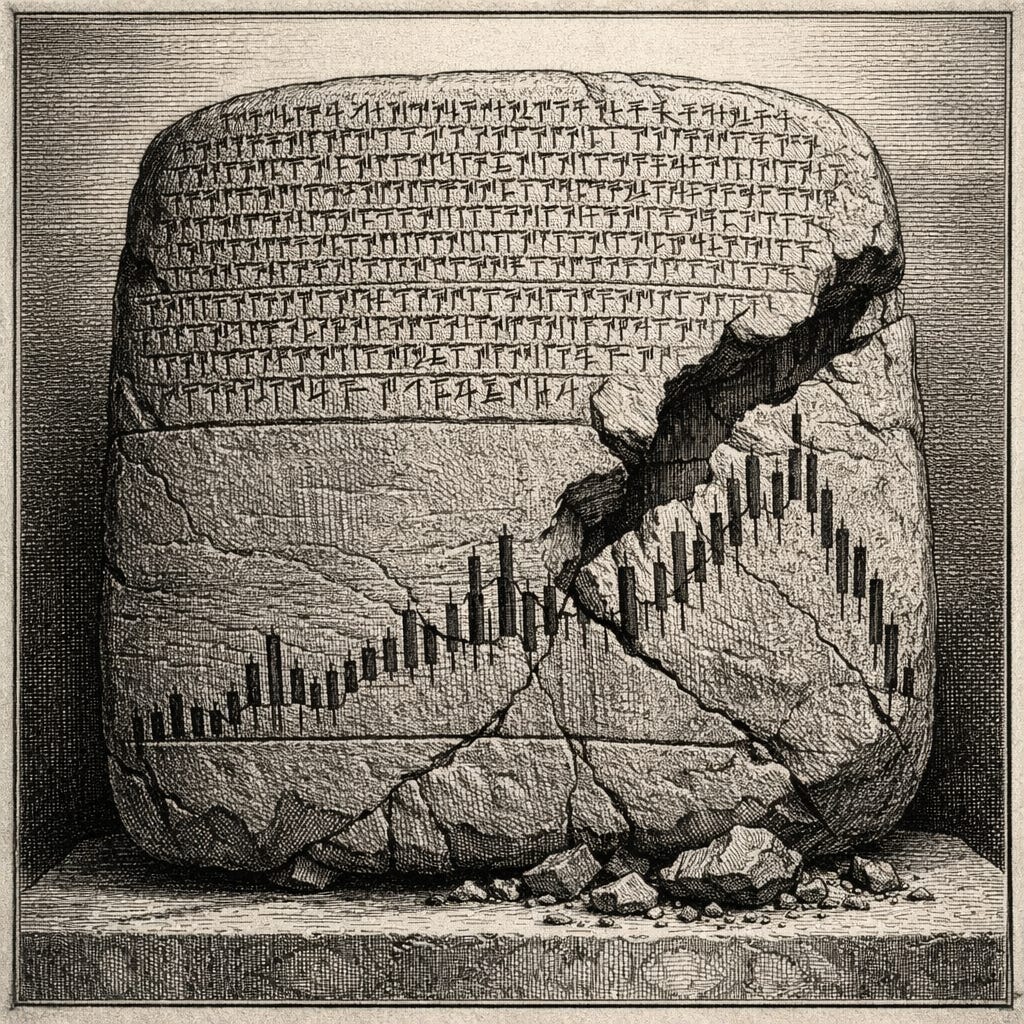
We treat financial crises like unsolved engineering problems. If only we had better models, smarter regulators, faster data feeds. The entire apparatus of modern financial regulation—Basel accords, stress tests, macroprudential surveillance. We assume the core challenge is diagnosis, like we just haven’t figured it out yet.
We figured it out before the alphabet.
The Barley-Silver Distinction
For roughly three thousand years—from ancient Sumer through Babylonia, the Hebrew kingdoms, Greece, and Rome—periodic debt cancellation was standard economic policy. Not utopian theory. Not a fringe religious practice. Documented, enforced, routine. The Sumerian word was amargi. The Babylonian term was misharum. The Hebrew version became the Jubilee. The tradition was old enough to be ancient by the time Rome was fighting over it. Different languages, same mechanism, same math.
The mechanism had three parts, repeated across centuries with remarkable consistency. Agrarian and subsistence debts—what we’d call household debt—were periodically cancelled outright. People who had fallen into debt bondage were freed. And pledged land was returned to its original holders, reversing the concentration that had accumulated since the last reset.
But here’s the part that should make every institution that’s ever claimed to be “too big to fail” nervous. Commercial debts between merchants were left intact.
The Babylonians called it the barley-silver distinction. Barley debts—subsistence borrowing, accumulated taxes, unpaid fees, the arrears of people whose obligations grew faster than their harvest—got cancelled. Silver debts—commercial credit between traders, self-liquidating loans extended for specific ventures—didn’t. The distinction isn’t complicated. A farmer who owes more grain than his field can produce ends up a debt slave—and a debt slave doesn’t run a farm. A merchant who borrows to ship copper and repays from the proceeds is just doing business. The Babylonians could tell the difference. So can you.
The debtor class wasn’t a collection of irresponsible borrowers who’d overextended themselves on Bronze Age McMansions. Most of these obligations weren’t even loans in the modern sense—credit preceded cash by millennia. They were families whose arrears accumulated faster than the harvest could cover. Compound interest doesn’t care about drought years. Enough time, enough families, same result every time.
The scribes knew this. The clean slate wasn’t charity. It was scheduled maintenance.
The Capture Sequence
If this system worked—and the archaeological record suggests it did, across multiple civilizations and millennia—the obvious question is: what happened to it?
It was destroyed. Specifically, it was destroyed by the people it constrained, using techniques that haven’t changed much in four thousand years.
The sequence is documented repeatedly—in fragmented clay tablets and fragile papyrus scrolls and yellowed parchment—and it is remarkably consistent:
First, an institutional mechanism protects the broad population from excessive wealth concentration. The clean slate, the Jubilee, Roman agrarian laws—the specific form varies, the function doesn’t.
Second, the beneficiaries of concentration develop workarounds. Fictive adoptions to circumvent inheritance rules. Contractual waivers where debtors “voluntarily” surrender their protections. Temple-precinct pledging to move assets beyond the reach of royal decrees. The loopholes are always more creative than the rules.
Third, the mechanism’s enforcers are killed, captured, or politically neutralized. Sparta’s kings Agis and Cleomenes were murdered for attempting debt cancellation. The Gracchi brothers were killed for pursuing land reform in Rome. Caesar was assassinated by a Senate heavy with creditor interests.1 The pattern isn’t subtle.
Fourth—and this is where it gets elegant—the mechanism is formally maintained but substantively gutted. The letter of the law survives. The spirit doesn’t. The single best example is Hillel’s prosbul, invented in the first century BC. Faced with the Torah’s Jubilee requirement to cancel debts every seven years, Rabbi Hillel created a legal clause allowing borrowers to “voluntarily” waive their protections. Sign here, and the sacred debt cancellation no longer applies to you. The ancient equivalent of clicking “I agree” to the Terms of Service—coercion dressed as consent, with just enough procedural formality to satisfy anyone not looking too hard.
Two thousand years later, we still use the same technique. Every credit card agreement, every adjustable-rate mortgage, every arbitration clause buried in the fine print of a contract nobody reads is a direct descendant of the prosbul. The innovation wasn’t financial. It was legal. Make the surrender of protections look like a choice, and nobody has to take them by force.
Fifth, and finally, wealth concentrates to the point of systemic failure. Rome is the endgame that played out completely. The early Republic had land distribution laws, debt limits, and a citizen-soldier class whose economic independence was the foundation of military power. Over several centuries, the creditor oligarchy dismantled every constraint. Public land was absorbed into private latifundia, industrial-scale farms worked by slaves and owned by the elite. The citizen-soldier was replaced by a professional army loyal to individual oligarchic generals. The tax base hollowed out. Military capacity degraded. Political legitimacy collapsed into factional warfare. The barbarians at the gates hadn’t changed. Rome’s internal structure had.
What makes Rome instructive isn’t the fall—empires fall. It’s that the people with the power to implement the correction were precisely the people who benefited from not implementing it. The solution existed. The political will to deploy it had been captured.
Why the Fix Never Comes From Below
There’s a tempting populist reading of all this: if the elites won’t cancel debts, the people should demand it. But this misreads the entire historical record. The clean slate was never a populist achievement. It was always an elite correction—one faction of the elite constraining another.
The Babylonian king cancelled debts not because the masses demanded it, but because the palace needed a functioning tax base and a military drawn from free citizens, not debt slaves. The king’s interests diverged from the creditor class’s interests. That divergence was the mechanism. The masses didn’t need to understand compound interest. They needed a ruler whose survival depended on not letting creditors cannibalize the productive base.
This maps uncomfortably well onto today. The people who feel the squeeze of wealth concentration want to “make billionaires pay their fair share”—but the mechanisms through which concentration actually operates are opaque enough that the policies voters demand often mechanically worsen the problem they’re trying to solve. This isn’t a failure of character. It’s the same structural mismatch the Babylonians identified: expecting the barley class to diagnose a silver disease.

The uncomfortable implication: the correction for financial capture has never come from below. It comes from elite fragmentation—when a faction within the ruling class has both the understanding and the motivation to build counterweights. It’s never the Occupiers versus Wall Street. It’s the Babylonian palace versus the creditor class. The Roman populares versus the optimates. When the elite is unified in its interests, there is no correction.
The rest of us just feel the squeeze.
The Complexity Defense
Modern finance has made the barley-silver distinction functionally impossible. When a mortgage is sliced into tranches, bundled into a collateralized debt obligation, insured by a credit default swap, and held as Tier 1 capital by a bank that clears every transaction in the economy—and then issues credit cards—there is no clean seam to cut along. The Babylonian palace could see every debt because debts were recorded on clay tablets in temple archives. In modern finance, the debt is the money supply. Cancel the debt, cancel the money.
In 2008, the banks really were too interconnected to let fail—not because bankers are special, but because the system had evolved to make the correction mechanism and the correction target the same thing. The clean slate presupposes that you can distinguish what to cancel from what to preserve. Structured finance has made that distinction impossible by design.
And there’s a deeper tradeoff that honest advocates of debt relief have to confront: making the barley-silver distinction doesn’t just reset bad debt. It means less barley credit gets extended in the first place. A lender who knows subsistence debt gets cancelled every cycle will lend less to subsistence borrowers. The Babylonians accepted this—and the economy functioned. The modern system chose the opposite: maximize credit availability, socialize the downside, and call it financial inclusion. More people get loans. More people get buried. The banks get bailed out. We call it a safety net.
Whether the complexity itself is a feature of capture—the system made opaque specifically to prevent correction—or a genuine emergent property of financial innovation is a question worth sitting with. Both are probably true. Financial systems do grow more complex over time for legitimate reasons. And complex systems are harder to reform, which benefits the people who’d rather not be reformed. The two dynamics reinforce each other until you get a financial system that is simultaneously too intricate to understand and too interconnected to reset.
Who Bears the Risk
The standard economics curriculum treats debt as a neutral instrument—a contract between willing parties, priced by the market, cleared by the legal system. Default is treated as an individual failure of the borrower. But four thousand years of evidence suggests something simpler: most people aren’t going to end up on the right side of the compounding equation. They never have. The question is whether we design systems that expect them to, or systems that accept it.
The Babylonians didn’t solve household debt by teaching farmers compound interest. They solved it by making the system absorb the reality that farmers would never beat compound interest. The barley-silver distinction wasn’t taught to barley debtors. It was imposed on silver creditors. The lender bore the risk of extending credit that wouldn’t always be repaid, because the system would periodically cancel it. That didn’t punish lenders. It made them careful. A creditor who knows the slate gets cleaned prices accordingly—extends less, charges less, or doesn’t extend at all.
We’ve built the opposite. Capital One will extend you $30,000 in revolving credit at 27% APR—not despite knowing you can’t sustainably service it, but because the system ensures you can’t escape it. Bankruptcy reform in 2005 made credit card debt harder to discharge. Student loans are effectively permanent. The entire consumer credit apparatus is engineered around the principle that barley debtors must pay, no matter what. This isn’t lending. It’s farming.
The mechanism doesn’t have to be a Jubilee. It doesn’t have to be a specific law. But the standard it points toward is clear: the entity extending credit should bear the cost when that credit can’t be repaid. Not as punishment—as systemic maintenance. Make the silver side eat the barley risk, and the silver side will figure out very quickly how much barley credit the system can actually sustain. They’ll do the math. That’s what they’re good at.
Babylonian scribes used clay tablets and concluded that periodic debt correction was necessary infrastructure, like irrigation. We run the same numbers on supercomputers and arrive at the same conclusion—but we’ve decided the answer is to make the borrowers smarter rather than the lending safer. The math hasn’t changed. The politics has.
Among other things. The Ides of March had several fathers.