
Ask anyone what makes a market economy work and they’ll say competition. Firms compete for customers. Workers compete for jobs. The invisible hand turns self-interest into collective welfare through competitive pressure. It’s the engine, the organizing principle, the thing that separates us from the Soviets. Greedy, self-interested, ruthless competition is what capitalism is. It’s the one thing that Ayn Rand and Che Guevara agree on.
And it’s wrong.
If you actually measured the economy by the volume of transactions that are cooperative versus competitive, you’d have a hard time finding much competition at all. Cooperation would be almost the entire picture. We’ve named the whole system after the thin, selective edge of market rivalry, like naming the Gulf of Mexico America the “Coast of Texas,” which, honestly, Texas might be open to.
Inside the Machine
Pick any company. Inside it, the governing principle is coordination, not competition. Engineers build components that fit together. Sales teams celebrate each other’s deals. Production lines synchronize. Nobody runs a company by having the marketing department compete with IT for survival.
We actually know what happens when companies try to make their insides competitive, because Enron tried it. Jeff Skilling’s rank-and-yank system—fire the bottom 15% every year, force employees into zero-sum competition for survival—was celebrated as Darwinian genius, right up until it wasn’t. Traders hoarded information. Teams sabotaged each other. The company that was supposed to prove the power of internal competition became the most spectacular corporate collapse of its era. That wasn’t a coincidence. Within-group competition destroys between-group performance. Always has.
The irony is that the most successful “capitalist” enterprises on Earth are internally planned economies. Apple doesn’t let the iPhone division bid against the Mac division for engineering talent on an open market. It allocates resources by committee — who works on what, how much they’re paid, what gets built. So does Google. So does every company that’s ever functioned. The invisible hand is what happens between firms. Inside them, it’s coordination all the way down.
Think About Your Week
Even between firms, the competitive layer is thinner than the textbook suggests. You don’t price-shop which grocery store to visit every Saturday—you go to the same one, because it’s close, you know where your favorite chips are, and the checkout girl is cute. You don’t wake up and scour job boards to decide who to work for today. You commute to the same place on autopilot. You don’t renegotiate with your landscaper every spring, or run a competitive bid for who gets to cut your hair this month, or comparison-shop your mechanic against every other mechanic in the tri-state area. You have a dentist. You have a dry cleaner. You have a guy.
Almost all of your economic life is repeat relationships with people you trust, conducted on the basis of familiarity and habit rather than price competition. The textbook economy—anonymous buyers meeting anonymous sellers in open price-clearing markets—is something you dip into occasionally. The relationship economy is where you actually live.
And it didn’t happen by accident. Your barber earns your repeat business by remembering how you like it cut. Your mechanic earns it by not ripping you off when he could. The restaurant on the corner earns it by knowing your name. These aren’t sentimental observations. They’re economic ones. Trust is a capital asset. It compounds. Every honest transaction makes the next one cheaper, because you skip the due diligence, the comparison shopping, the contract negotiation. The cooperative economy isn’t just warm and fuzzy—it’s efficient. It’s where transaction costs go to die.
The Three Floors
The historian Fernand Braudel spent decades studying economic life from the fifteenth century to the eighteenth, and what he found was a three-layered structure that has never been seriously challenged.
The ground floor is what Braudel called material life—self-sufficiency, routine, household production. People sowing wheat as they always had, cooking food as they always had, making clothes and tools and shelter through patterns handed down across generations. Even today, the non-market economy—home cooking, childcare by parents, favors between neighbors, DIY repairs, the uncounted labor that holds daily life together—represents 30 to 40 percent of GDP-equivalent activity in industrialized countries. A third of the economy doesn’t even show up in the economy. It’s paid in pizza and beer, when it’s paid at all.
Above material life sits the market economy—the zone of transparent local exchange where producer meets consumer, prices are visible, and competition operates within known rules. The butcher, the baker, the candlestick maker. It’s real, and it functions roughly the way Adam Smith described, and it’s most of the tracked economy.
But Braudel’s most provocative claim is about the layer above that. What we call capitalism—the zone where a few powerful actors accumulate wealth, manipulate long-distance trade, and concentrate market power—is not the fulfillment of the market economy. It’s the opposite. Braudel calls it the “anti-market.” It operates by escaping competition, not by embodying it. The great merchant houses of Amsterdam, Genoa, and Venice didn’t seek perfect competition. They sought monopoly, information asymmetry, privileged access, opacity. The entire point was to get above the transparent market layer and stay there.
So the three floors of the economy are: routine cooperation at the base, trust-based exchange in the broad middle, and monopolistic escape from competition at the top. Competition—the thing we named the whole system after—doesn’t have its own floor. At best it’s a narrow hallway.
Why We Show Up
Your barber cuts your hair for twenty bucks. But he also likes seeing your reaction in the mirror when he’s done, because it’s a craft and he’s good at it. Your coworker stays late to help you fix the presentation not because her incentive structure rewards it but because she likes you and you suck at designing slides. You use your brother-in-law as a realtor because he’s family, sort of. You sponsor the local Little League team, and the logo on those jerseys isn’t a calculated ROI play—but Coach Davis asked and you’ve known him since high school.
People work for money, sure. But they also work for pride, for purpose, for identity, for the look on someone’s face when the thing they built actually works. They show up for each other in a thousand ways that never clear a market and never appear in a model. The cooperative economy isn’t an abstraction. It’s how communities get built. How neighbors become friends. How people find out what they’re good at and offer it to each other.
That’s capitalism in its ordinary form. Not the competitive baggage we’ve attached to it—the thing you actually experience. People showing up, building trust, solving each other’s problems, and accumulating the kind of capital that doesn’t show up on a balance sheet1 but determines almost everything about the quality of your life. The most productive system humans have ever built at scale, and it works so well that we’ve stopped noticing how much of it is pure, voluntary cooperation.
What the Mislabeling Costs
Which is why getting the name wrong isn’t just a semantic quibble. Call the system “competitive” and you produce a specific, predictable distortion: you tell people that competition is what they’re losing to.
When housing is unaffordable, healthcare bankrupts families, and a degree costs six figures, the narrative writes itself: capitalism did this. The ruthless, dog-eat-dog market did this. And the prescription follows naturally—if competition is the disease, restrain it, regulate it, replace it. Burn it down if you have to.
But the cooperative economy didn’t do any of that. Housing costs aren’t high because local homebuilders are competing too hard. Healthcare isn’t expensive because doctors are locked in cutthroat rivalry for patients. Tuition didn’t triple because universities are engaged in ruthless price competition. Those failures live on Braudel’s third floor—the anti-market, where regulatory capture, monopolistic rent-seeking, and institutional self-preservation have escaped both competition and cooperation.
The mislabeling collapses all three floors into one word and tells people to be angry at the whole building, instead of the upstairs neighbors. That’s how you get a narrative where participating in the market economy feels like complicity rather than cooperation—where showing up and being useful starts to feel naive. If someone tells you the ocean is poison, you won’t swim. And you won’t be wrong for staying on the beach. You’ll just be wrong about the ocean.
Aim at the Right Floor
The problems are real. Insurance companies adding 30% overhead to healthcare—real. Zoning boards protecting incumbents from new housing—real. The tax code capitalizing deductions into home prices and locking out first-time buyers—real. Credential inflation pricing a generation out of careers that don’t really require four-year degrees—real. We can point to dozens of stripped gears in the economic machinery, and we should.
But every one of those failures lives on the third floor. Every one is an instance of powerful actors escaping the cooperative economy—using regulation, complexity, and institutional capture to extract rent from people who are just trying to show up and be useful. The third floor is the part we should be tearing apart. That’s where the bathwater is. The rest of it is the baby.
The ground floor and the middle floor—the parts where you actually live—work. They work because people show up, build relationships, and honor commitments. They work because millions of ordinary transactions, conducted on trust and habit and mutual benefit, compound into something that looks from the outside like an economy but feels from the inside like a community. The plumber who answers his phone on weekends, the contractor who has a spare part in his truck, the freelancer who delivers what she promised—they’re not winning a Darwinian competition. They’re cooperating, iteratively, with a growing circle of people who trust them. And that trust is compounding into a life.
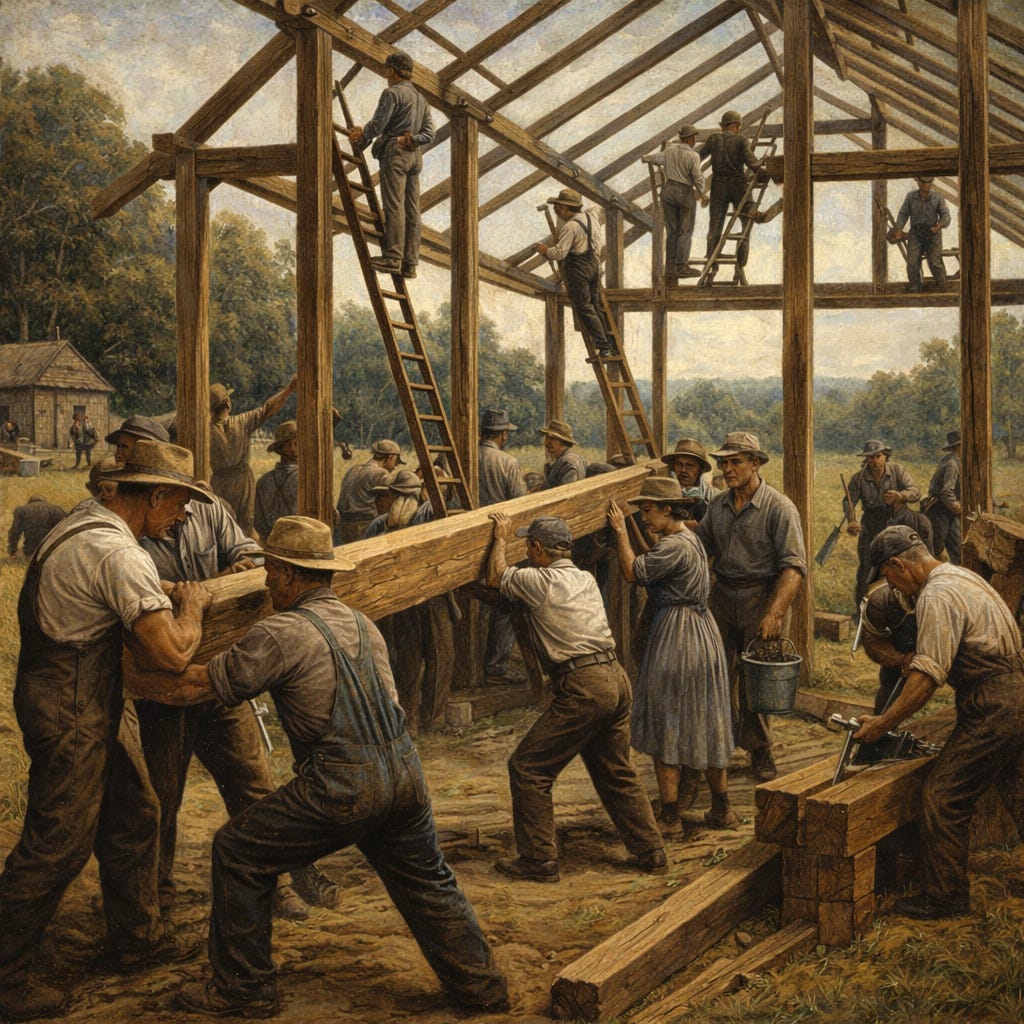
The cooperative economy doesn’t require capital. It doesn’t require credentials. It requires showing up and being useful, and the patience to let that usefulness compound. It’s a barn raising, not a cage fight—the most accessible game in the history of the species. The tragedy of the mislabeling isn’t just that it aims reform at the wrong floor. It’s that it convinces people that not showing up is the rational move.
We named our economic ocean after its coastline. But the ocean is where we swim.
Actually, for corporations it can, it’s called “Goodwill” and it’s an intangible asset under GAAP (Generally Accepted Accounting Principles).