
Over the last 250 years, the United States has systematically stripped the hereditary principle from every major domain of power. Political power went first—the Revolution was, at its core, a rejection of inherited governance. We encoded it into the Constitution, Article I, Section 9: “No Title of Nobility shall be granted by the United States.” No kings, no lords, no aristocracy, we haven’t argued about it since. Military power followed—the British abolished the purchase of officer commissions in 1871—the Cardwell Reforms, pushed through after the catastrophic mismanagement of the Crimean War. Selecting cavalry commanders by bloodline instead of competence produces the Charge of the Light Brigade.
Professional power completed the pattern in the late nineteenth and early twentieth centuries, as standardized examinations and licensing replaced guild inheritance and family apprenticeship. A surgeon’s daughter doesn’t inherit the scalpel. She takes the MCAT, survives medical school, matches into a residency, and passes board certification. The credential expires with the person who earned it.
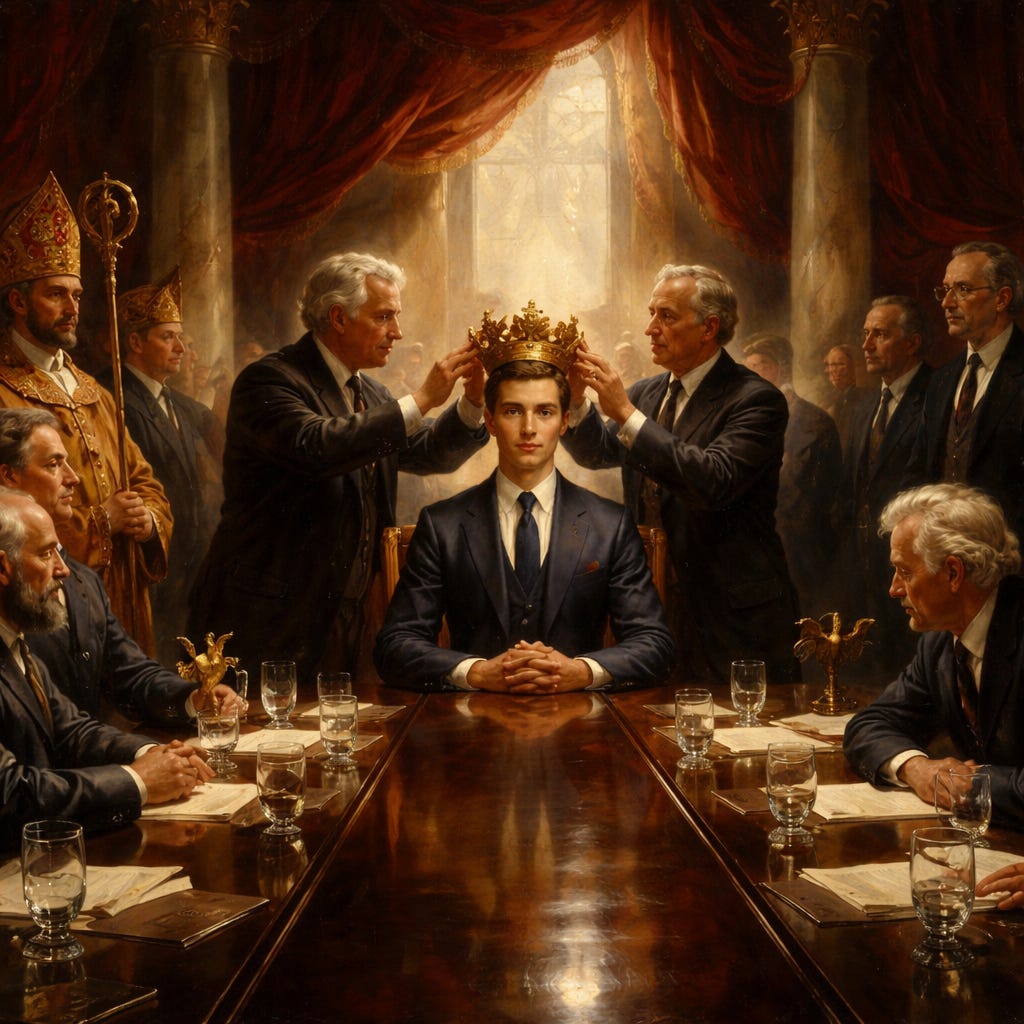
The principle was the same each time: power must be earned, not bequeathed. A title held by one generation conveys nothing about the competence of the next.
Of course, dynastic advantage persists in all three domains, and everyone knows it. A senator’s kid has name recognition, donor networks, and twenty years of dinner-table education in how power works. A general’s kid grows up on bases, absorbs military culture, and understands the institution before his first commission. A surgeon’s kid benefits from family wealth that can fund a decade of training, legacy preferences, and parents who know exactly which residency programs to target.
These advantages are real and significant. But the formal entitlement is gone. The senator’s kid still has to win the election. The general’s kid still has to pass the selection board. The surgeon’s kid still has to get licensed. Between the advantage and the power, there is a proving ground—a gate that won’t open on pedigree alone. The dynasty can tilt the odds. It cannot skip the test.
Economic Empires
Economic power has no such test.
The Walton heirs collectively hold roughly $250 billion. Sam Walton built Walmart. His children and grandchildren didn’t. They hold more wealth than the bottom 40% of American households combined, and the mechanism that transferred this power to them involved no election, no exam, no selection board, no credential check, no demonstrated competence of any kind. A will executed. A fortune moved.
In every other domain, inheritance is an unlawful advantage. In economics, it is the norm. A senator’s kid with every dynastic edge still has to win an election. An heir just has to have a pulse.
Biology and Society
Of course, parents want to leave their children what they built. That instinct is as natural as they come. But it was equally natural in every other domain. Kings wanted their sons to rule. Generals wanted their sons to command. Doctors wanted their sons to practice. The desire to pass power to your children is one of the oldest forces in human life. It is also one of the most consistently overridden by law, because the damage it does to society outweighs the comfort it provides to our biological urges.
Natural impulses get legally overridden all the time. If your kid commits tax fraud, you may want to help cover it up. The law says you can’t. If your kid fails the bar, you don’t get to practice law on their behalf, either. The instinct to protect and provide for your children is deep, real, and irrelevant. All of our laws are designed to override our base nature. That’s what a civilization is. In politics, the military, and the professions, the answer has always been to overrule this impulse—and we’re better off for it.
But the desire to provide for your children and the drive to build a billion-dollar business are not the same instinct. The people who create enormous fortunes aren’t doing it for their grandchildren. They’re doing it because they’re obsessed. Bezos didn’t grind through early Amazon dreaming of a trust fund. Musk isn’t sleeping at the factory for estate planning. The drive to build is intrinsic—that’s the entire capitalist argument for tolerating unequal rewards. The inheritance isn’t the motivator.
The real reason the exception persists is power, not instinct. The people who benefit from inherited wealth have the resources to keep the system in place. The Lords didn’t vote to abolish the Lords. The purchasers of commissions didn’t volunteer to end the purchase system. Every time, the change came not because the beneficiaries agreed but because something broke hard enough to override them. In 1990 the top 0.1% held 8.5% of the wealth. By the end of 2024, it had grown to 13.8%. The 19 richest U.S. households added about $1 trillion in wealth in 2024 alone.
Something is broken.
Estate Taxation
Here’s how the estate tax actually works, since most Americans have never had reason to learn. When someone dies, their estate is valued—everything they owned. The federal government exempts the first $15 million per individual from taxation.1 For a married couple, that’s $30 million. Everything above the exemption is taxed at 40%. Everything below it is untouched.
Most people can intuit the obvious loophole with this—just give it away on your deathbed. So our laws handle that too. Anyone can give $19,000 per year to any recipient, tax-free. But larger gifts count against the total estate exemption—give your daughter $1 million this year, and your estate exemption at death drops by $1 million.2 The system treats large gifts and inheritance as two draws from the same pool.
The median American estate is roughly $300,000. The current exemption is $15 million. Only about 0.1% of estates currently owe anything at all. And even those estates, after trusts and avoidance strategies, pay an effective rate of about 3.5%. The estate tax collects roughly $35 billion a year on over $1 trillion in transfers. Functionally, it’s more of a suggestion than a rule.
Every argument against raising taxes is an argument about incentives. Income taxes discourage work. Capital gains taxes discourage investment. Sales taxes discourage consumption. These objections have force because they describe real behavioral distortions imposed on living people making real decisions.
Dead people don’t make decisions. A dead person has no labor supply to reduce, no investment to defer, no business to relocate, no income to shelter. The entire economic case against taxation is a case about distorting behavior, and a dead person’s behavior cannot be distorted. The deadweight loss of an estate tax is zero, because the taxpayer is dead weight.
This makes the estate tax unique in the tax code—the only tax where the standard economic objections don’t apply, because the entity being taxed no longer exists. The only tax with no economic cost is the one we barely collect.
Democratic Principles
The correct rate is 100%, because that’s the principle we already agree with. Nobody inherits 60% of the king’s title. Nobody inherits half a general’s stars. The credential, the rank, the office—they either transfer or they don’t. In politics, the military, and the professions, they don’t. A small exemption—$5 million per person, $10 million per couple—handles the obvious: the family home, the Mustang dad lovingly restored, the good china, the heirlooms that represent a family, not a dynasty. For the vast majority of families, nothing changes.
For wealthy families, most of the real advantage continues uninterrupted, too. Children still inherit relationships, access, family name, reputation—the same dynastic advantages that persist in every domain where formal inheritance has been abolished. The senator’s kid still has the donor network. The general’s kid still has the institutional knowledge. The same advantages apply here.
The financial tools for taking care of your family are already in the tax code. Parents can give $19,000 a year to each child, each grandchild, each in-law—anyone they want, as many recipients as they want, every year they’re alive. A couple with three kids and six grandchildren can transfer over $170,000 a year without touching the exemption. Over twenty-five years, that’s $4.25 million on top of the $10 million that passes at death. Tuition paid directly to a university, medical bills paid directly to a provider—none of that ever enters the tax system. Families can, and should, continue to help each other.
What the estate tax should eliminate is the lump-sum transfer of a dynasty—the fortune so large it replicates itself across generations regardless of what anyone does with it. That’s not a tax, it’s a principle. It’s how every other form of power in this country already works.
The revenue goes where it should have been going all along—toward the budget, toward infrastructure, toward programs like universal opportunity accounts that give every American a real starting position instead of a lottery based on who their parents were. The point isn’t to destroy wealth. It’s to stop pretending that a system which transfers dynastic fortunes is consistent with the principles of democratic and meritocratic power.
The Last Holdout
The hereditary principle has been on a 250-year losing streak. Each time it was abolished, the beneficiaries of the old system predicted catastrophe. The aristocrats said democracy would produce mob rule. The officer class said meritocratic promotion would destroy military cohesion. The guild families said open licensing would flood the professions with incompetents. Each time, they were wrong. Each time, the system that replaced inherited power with earned power outperformed the one it replaced.
Economic power is the last holdout, and the biggest. A modern dynastic fortune concentrates more power than a medieval lordship, a purchased commission, and an inherited credential combined. The principle that applies to it is not new, not radical, and not untried. It has been tested at least three times, in three domains, across three centuries.
You get a lifetime to earn wealth, spend it, give it away, and use it however you see fit. That’s the deal. That’s what a free society offers. But the deal is with the living. When it’s over, it’s over. We abolished the inherited title. We abolished the purchased commission. We abolished the hereditary credential. There’s one last holdout. Let’s abolish it.
The 2026 federal estate tax exemption.
Technically $981,000, since the first $19,000 of a gift is tax-free each year, but who’s counting?