
For five months in 2023, Hollywood went on strike. The Writers Guild led; SAG-AFTRA followed. The dispute was framed in the usual moral register—workers versus corporations, the dignity of craft, the threat of automation. The specific demand that drew the most attention, and ultimately the most concession from the studios, was protection against artificial intelligence. Studios agreed not to use AI to write screenplays, not to train AI on writers’ work without consent, and not to credit AI as a writer.
The thing the public was being asked to worry about was that some kid with a laptop and a chatbot might one day make a hit movie without paying Hollywood dues first.
This is a real concern for the incumbents. The Hollywood ecosystem is one of the most concentrated wealth pyramids in America. WGA minimum scale for an original screenplay starts at roughly $80,000 and tops out near $150,000—a floor that pays the worst-paid WGA member, on a single project, more than the median American household earns in a year. Working SAG-AFTRA actors clear $1,200 a day at scale. Established writers clear seven figures. A-list actors clear nine figures per blockbuster. The studio executives clear ten. Every union victory in this fight defends an “injustice” that most Americans can only dream of.
In some sense, the strike won. The clauses are in the contract. But it’s a Pyrrhic victory. It does not stop a kid in Austin with a laptop from making the next breakout hit with a chatbot. It only guarantees that when one does—and one will—Hollywood will be contractually obligated to keep making movies the slow, expensive way while the rest of the world does not. The victory locks in a cost disadvantage. That’s the real story, and what happens next is predictable.
The Argument Has Been Made Before
“This new technology will destroy jobs” is a reliable feature of every wave of technological displacement in history. It’s also, in retrospect, the side of the argument that loses every time, at least in the long run.
In 1894, New York City had about 150,000 horses producing 2.5 million pounds of manure a day. The manure-removal industry was substantial. So were the stable industry, the carriage industry, the feed industry, and the long chain of small businesses that assumed horses were essential to how cities worked. When the automobile arrived, every one of those industries sounded the alarm—in the language of public safety, public health, and public morals. Cars were too fast. Cars were too loud. Cars would frighten children. New York seriously debated, and in some places imposed, laws limiting cars to walking speed. The carriage drivers were the loudest voice, because the carriage drivers had the most to lose.
You know how this ended. The displaced industries are footnotes. Nobody alive thinks New York should have stuck with the horse, and nobody alive even remembers the smell. They don’t have to.
The travel agents went the same way. When Expedia and Travelocity arrived in the late 1990s, the trade press filled with warnings about lost expertise, fraudulent bookings, missed connections, and the death of personalized service. Some of the warnings were even true. The industry lost about two-thirds of its agents within a decade, and air travel became cheaper and more accessible than at any point in human history. The people who lost their jobs deserved sympathy. What they didn’t deserve was a regulatory regime requiring human review of every online booking, externalizing the costs of their irrelevance onto every traveler everywhere.
The coal miner of the 2010s heard the same melody in a different key. His industry needed to die for the climate, the editorial pages explained. The just-transition support would arrive. He could retrain into solar installation, or move to a city, or—the favorite line—learn to code. He didn’t get the just-transition support, of course. The solar jobs went to West Texas, not West Virginia. The towns hollowed out. The editorial pages turned to the next round of advice for the next group getting displaced, as they always have.
This is creative destruction. The labor market adjusts. Progress requires winners and losers. Only the losers fail to see it.
This Time It’s Different
Every previous wave of displacement automated muscle and motion. The loom, the assembly line, the container ship, the self-checkout—these replaced work that was physical, done by people whose labor was too. The advice was always the same: get an education, work smarter, not harder. Predictable advice from the class whose work is done with words, numbers, and credentials. The one that doesn’t have to worry about where their electricity comes from, just as long as it comes when they power on their laptop.
AI runs the other way. It automates the words and numbers. It commoditizes exactly the kind of work the credentialed class does—drafting, summarizing, analyzing, reviewing, classifying, recommending, advising. The knowledge workers. The first jobs visibly threatened by AI are not in coal towns or factories, this time. They are in law firms, marketing departments, junior consulting bullpens, radiology clinics, and editorial offices.
Which means, for the first time, the people inside the displacement zone are the people writing the columns explaining why displacement is good. Except, of course, this time they say it’s bad.
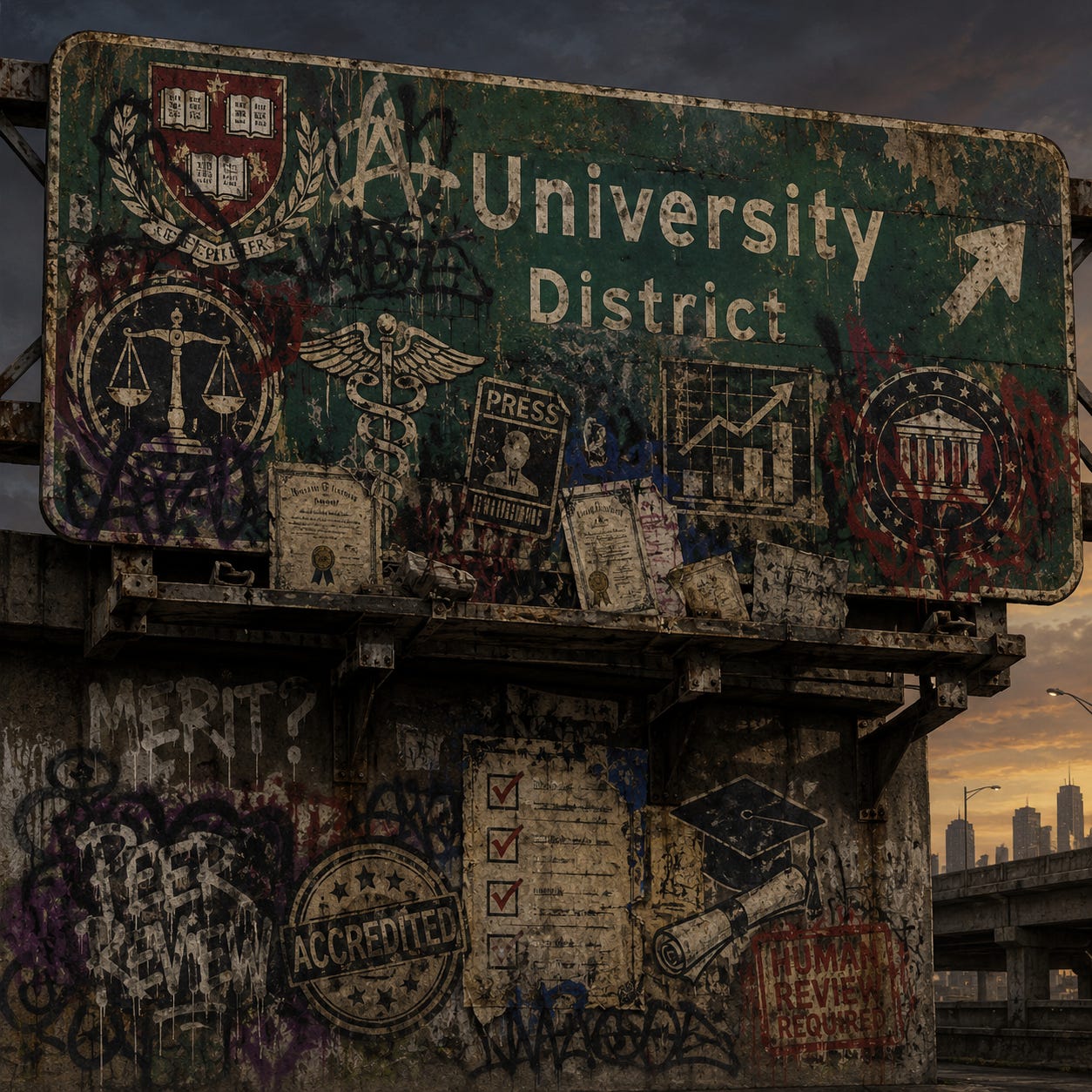
They are not a small group. They run the New York Times and the Atlantic and most of the journalistic institutions still standing. They run the universities and the academic journals. They run the state and federal regulatory agencies. They run the major NGOs and the major foundations. They run the legal profession, the medical licensing boards, the accreditation organizations, the standards bodies, the HR profession, the compliance industry, and the policy think tanks. They’ve run the executive branch of every administration since Eisenhower.
The state bar association can require, with great moral clarity1, that every AI-generated legal brief be reviewed and certified by an admitted attorney. The medical boards can mandate physician sign-off on every AI diagnostic recommendation. The academic journals can declare AI-assisted scholarship a form of academic fraud. The HR director can write the policy requiring human review of every algorithmic hiring decision. The compliance officer can have AI outputs themselves require compliance officers.
What every previous displaced class did was complain. What this one can do is mandate.
The Class Schumpeter Predicted
This isn’t accidental, and it isn’t new. The dynamic was anticipated, in unsettling detail, eighty-four years ago.
In 1942, the Austrian economist Joseph Schumpeter published Capitalism, Socialism and Democracy. The phrase the book is famous for—creative destruction—has been so thoroughly absorbed by business journalism that it’s become cliché. The book’s actual subject is something different. Schumpeter argued that capitalism would be destroyed, not by its failures but by its successes. The specific success in question was the expansion of higher education.
A wealthy society can afford to credential more and more of its young people. But the economy can only absorb so many credentialed workers into status-appropriate roles. The surplus, Schumpeter wrote, would “swell the host of intellectuals in the strict sense of the term whose numbers hence increase disproportionately. They enter it in a thoroughly discontented frame of mind. Discontent breeds resentment.”
This stratum—what we might call the technocrats, or the professional-managerial class, or the credentialed class—would become the system’s most articulate enemies. Not because they suffered the most under capitalism. Because they suffered the contradiction of being trained for a status tier the system didn’t need. And their hostility, Schumpeter insisted, was structural rather than principled. The intellectual works in a domain that isn’t, in any meaningful sense, tested by markets. Ideas are evaluated by other intellectuals. Tenure committees grade tenure candidates. The peer reviewer reviews the peer reviewer. A system in which ideas are evaluated by whether anyone voluntarily pays for them is intolerable to the intellectual class, because the intellectual’s entire self-concept depends on having superior discernment to the masses. The market, on the other hand, caters to the masses.
Schumpeter thought this class would, in time, try to kill capitalism and replace it with socialism. He got the first half almost right and the second half almost entirely wrong. The credentialed class didn’t need to overthrow capitalism. It found something more durable. It routed around the market by colonizing the institutions that produce the market’s rules. The regulatory state, the academic credentialing apparatus, the licensing boards, the standards organizations, the major foundations, the prestige media, the HR profession, the compliance industry—every layer of intermediation between economic activity and economic outcome—would be staffed and run by this class. Their labor would be insulated from market discipline not by abolishing markets but by making themselves the gatekeepers and toll collectors of every transaction important enough to matter in the market.
This is, more or less, the world we live in. It is also the world that AI is crashing into.
What That World Does Next
The mandates being drafted right now are diagnostic. It’s as true of screenwriters, as it will be of CPAs or HR generalists. Any job that requires legislation or a professional body to keep AI out is a job that has finished its run as value creation and started its transition into rent extraction.
That is not a durable position.
Even if US models are prevented from writing legal briefs, or providing medical advice, or doing the thousands of other jobs that credentialed knowledge workers do, it won’t matter. People will just use Chinese models, or Indian ones, or Zimbabwean ones, or whichever jurisdiction is not willing to defend the American rent-seeking class. The work that survives will be the work that didn’t need the mandate in the first place—the kind customers voluntarily pay for, the way they have voluntarily paid for skilled work for as long as customers and skills have coexisted.
For the young adult mapping a course in life, this changes the advice. The strategy that worked for the mid-twentieth century—get the degree, get the license, take your seat of professional privilege—is now the worst possible bet you can make. Credentialed gate-keeping is not going to outperform AI, with the wind at its back and trillions of dollars of capital behind it. But the path of building something a customer voluntarily pays for—a product, a service, a piece of software, a company—has never been cheaper or more accessible. The tooling that used to require a Series A, a team of ten, and a network of credentialed intermediaries can now be assembled by one motivated person with a credit card and the same chatbot the rent collectors will try to legislate against. The next decade is going to be the worst time in modern history to be a rent collector, and the best time in modern history to be a builder.
Once again, there will be winners and losers. The good news is we’re still picking teams.
The Filter
The next time you read a piece in a major newspaper about hallucinations in AI legal briefs, or an essay in a magazine warning that AI threatens journalistic integrity, or an open letter from academic researchers calling for a pause on AI development, there’ll be some truth in it. There always is.
But they’ll never say the obvious part: this time, they’re the ones getting displaced.
The journalist warning about misinformation has a job in journalism. The professor warning about cheating has a job in academia. The lawyer warning about hallucinations in legal briefs has a job in law. The policy researcher warning about alignment risk has a job at a policy think tank. None of them is wrong, exactly. All of them are arguing for restrictions on AI in their own labor market, framed as protection of the public, in the same way the carriage driver argued that horseless carriages were too dangerous for the streets and the travel agent argued that online booking was a haven for scammers.
So when they run the headline about AI hallucinating a bad legal brief and Congress is debating mandatory human review of all AI legal work, you’ll be reading the 2030 version of horseless carriages should be limited to walking speed. The only real question is whether or not you get cars, or that old horse shit.
And lobbyists.