
Every few years, the same ritual plays out. A government runs out of other people’s money, and someone suggests maybe spending less of it. What follows is predictable: politicians warn of catastrophe, agencies threaten to cut the most visible services first, and the public is informed that austerity would be devastating to the very people government exists to help.
The word itself has been weaponized. “Austerity” sounds like deprivation—cold meals and shuttered schools. It’s deployed the way a protection racket deploys threats: nice economy you’ve got here, shame if something happened to it. But even under austerity, the government would still spend trillions. Just fewer trillions.
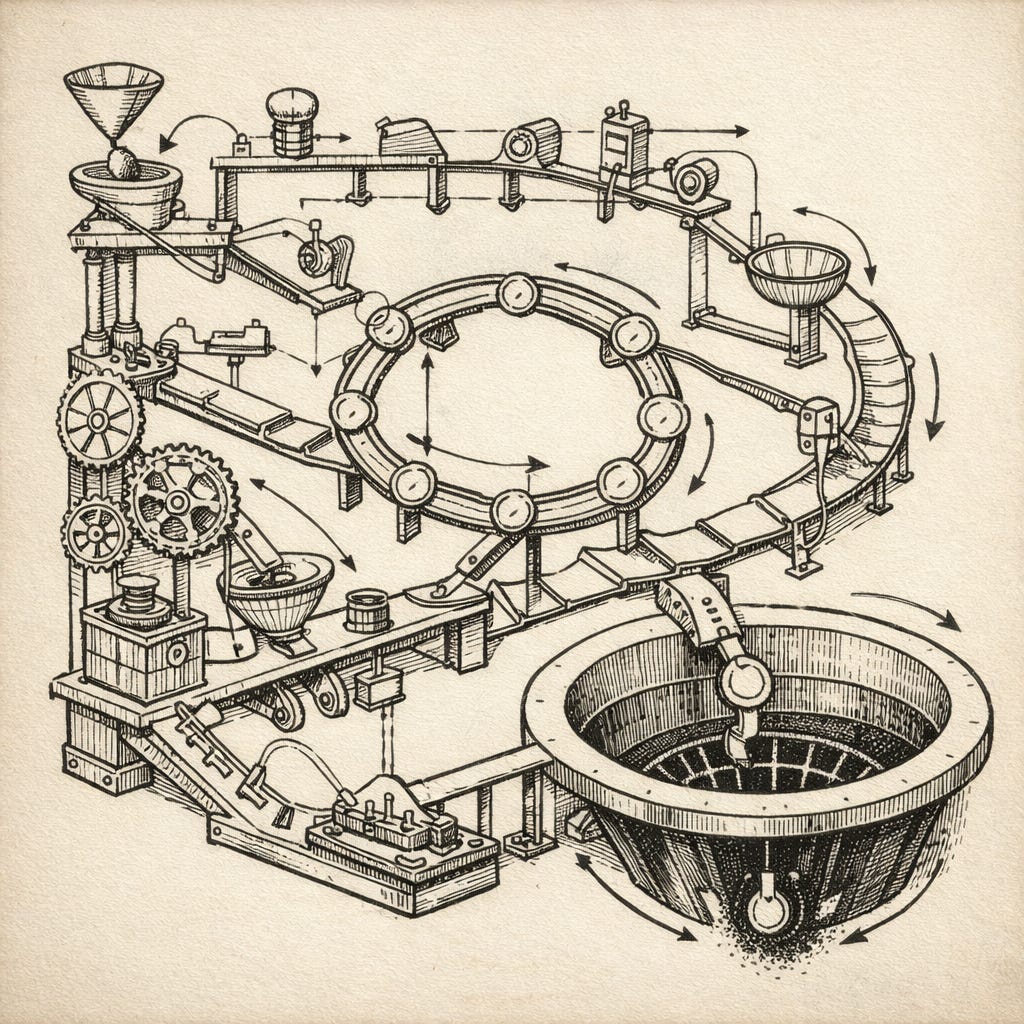
What they’d rather you not notice is that threat contains its own rebuttal. If the spending were working—if the trillions allocated to poverty, healthcare, education, and housing were producing results proportional to their cost—the fiscal crisis demanding austerity wouldn’t exist. You don’t need to cut a budget that’s generating returns. Stable enterprises don’t hold going-out-of-business sales.
The need for austerity is itself the evidence that the spending already failed.
Money Pits and Cash Drains
Not all government spending is created equal, and the distinction that matters isn’t between “wasteful” and “efficient” spending, or between “liberal” and “conservative” priorities. It’s between spending that can end and spending that can’t.
Call the first category money pits. They’re expensive—sometimes enormously so—but they have a bottom. Rural electrification. The interstate highway system. The eradication of polio. Putting a man on the moon. You set an ambitious goal, throw mountains of money at it, and eventually voilà. The pit is filled in. The project completes. What remains is a civilizational unlock that pays dividends for generations. Nobody is still funding the Rural Electrification Administration because rural America has electricity. Mission accomplished.
The second category is cash drains—spending commitments whose very definitions guarantee they can never be completed. These aren’t pits with a bottom. They’re open pipes.
Take poverty. The federal poverty line isn’t a fixed measure of deprivation—it’s adjusted annually for the cost of living, which rises in lockstep with the economy it’s measured against. Lift every household in America by 20% tomorrow, and within a few years the threshold has followed them up. Worse, the spending is deficit-financed. Deficit spending is inflationary. Inflation raises the cost of living. And the cost of living is exactly what the poverty line tracks. That’s not filling a hole. It’s digging it.
Or consider healthcare. The federal government funds medical research through the NIH, which produces genuine breakthroughs in treatment and diagnosis. Wonderful. But each breakthrough redefines the standard of care—which Medicare and Medicaid are then obligated to provide. The spending funds the innovation that raises the costs that the spending must then cover. There is no bottom in this pit. There are always more ways to extend or improve human life, short of curing mortality itself, and each new capability becomes the new baseline that “adequate” healthcare must meet. The better we get at medicine, the more it costs to provide it universally—not because of failure, but because of success.
The critical difference: money pits produce something and stop. Cash drains produce an obligation to spend more forever. One is an investment with a terminal date. The other is a subscription with no cancel button.
America’s budget crisis isn’t driven by money pits. We’re not going broke building highways. We’re going broke because the overwhelming majority of federal spending—entitlements, open-ended healthcare commitments, poverty programs pegged to relative measures—is structurally incapable of completion. These programs don’t fail and end. They fail and expand.
The Visibility Trick
What makes the austerity threat so hollow is that the economy isn’t struggling under this weight. It’s thriving despite it. The private sector funds itself, voluntarily. No one compels the investment, forces the trades, or conscripts the workers. A hundred and thirty million people show up because the exchange works for them. They earn enough to support themselves and their families directly and still generate a tax base of trillions to fund everything else.
The giant sucking sound isn’t the economy failing. It’s the economy succeeding so thoroughly that it can finance staggering waste and keep going. When politicians warn that spending less would hurt the economy, they have it exactly backwards. The economy is the source of the money. Austerity means pouring less of it down the drains.
The standard political playbook for resisting spending cuts is called the Washington Monument Strategy, named after the National Park Service’s habit of threatening to close its most popular attraction whenever its budget faced reductions. The logic is transparent: make the public associate budget cuts with the loss of something they value, rather than with the elimination of something they’d never notice.
It works because most people reasonably assume that if a program exists, it must be doing something important. But this misunderstands the nature of government institutions. Programs don’t persist because they work. They persist because they employ people, service contractors, and generate the kind of activity that registers as GDP. A program can fail completely at its stated mission while succeeding entirely at its institutional one: perpetuation.
This is why threatened “cuts” almost never start with the back office. They start with teachers, firefighters, and air traffic controllers—the employees the public actually interacts with. The administrative layers, the compliance departments, the consultants who study whether the consultants are needed—those are never on the chopping block. They’re the ones drafting the press releases about how devastating the cuts will be.
The Austerity Paradox
The numbers confirm what the structure predicts. Federal spending on poverty has increased for sixty years while poverty rates remain largely unchanged. Education spending per pupil has roughly tripled in real terms since 1970 while test scores have fallen. Healthcare spending has grown at multiples of GDP growth while life expectancy lags every peer nation.
If these programs were working, the spending would be shrinking. Each dollar would solve a piece of the problem until the problem got smaller and the budget could follow it down. Instead, the spending grows because it isn’t working—and the programs’ structural design guarantees it never will.
So when the bill comes due and someone suggests spending less, we’re not being threatened with the loss of effective services. We’re being threatened with the reduction of a bureaucratic apparatus that has demonstrably failed to deliver on its promises.
What Austerity Actually Looks Like
Canada in the 1990s cut federal spending by roughly 20% over four years. The predicted catastrophe never materialized. The economy grew, the budget balanced, and the programs that survived were the ones that actually delivered value. Estonia after the 2008 crisis chose austerity over stimulus when every respectable economist called it suicide. Their economy recovered faster than their stimulus-spending neighbors.
Argentina offers the most recently vivid case. When Javier Milei took office in December 2023, annual inflation was approaching 300%. He took a chainsaw to the federal budget—literally, his iconic campaign prop—and every credible institution predicted collapse. Eighteen months later, monthly inflation had fallen below 3%, the government posted its first fiscal surplus in fourteen years, and the poverty rate dropped to its lowest level since 2018.
The pattern is consistent: forced discipline eliminates the lowest-value spending first, because that spending has the weakest constituencies and the least defensible outcomes. What survives is, almost by definition, what people actually need. The overhead burns off. The core remains.
This shouldn’t surprise anyone. It’s how every other institution on earth operates. When a company faces a revenue shortfall, it cuts the projects that aren’t working. When a household tightens its budget, the magazine nobody reads gets cancelled before the grocery bill. Only in government does the opposite logic prevail: threaten to cut the groceries, then use the natural outcry to protect the unread magazines.
The debate over austerity is always framed as: can we afford to spend less? The question it dodges: can we afford to keep spending like this—on programs structurally incapable of completion, funded by debt our children will service for the rest of their lives?
Austerity is not a policy choice. It’s what happens when the bond market loses patience. Spending cuts have real costs—people depend on these programs even when the programs fail at scale. But the alternative isn’t just to continue spending indefinitely. It’s forced restructuring under crisis conditions, with little control over what gets cut and no time to protect what works. Now that’s what a threat sounds like.