
A hammer is only a tool. Its purpose is to build things—a bookshelf, a treehouse, a front porch you’ll sit on for the next thirty years. The point of a hammer is not to collect as many hammers as possible. Nobody dies rich in hammers and calls it a life well lived.
Money works the same way. It’s a tool. You use it to build the life you want. And yet somewhere between the invention of the 401(k) and the rise of the TikTok influencer, we convinced ourselves that accumulation was the point—that the person with the most hammers wins. That anyone who spends their tool on something that doesn’t generate a return is doing it wrong.
Which brings us to lottery tickets.
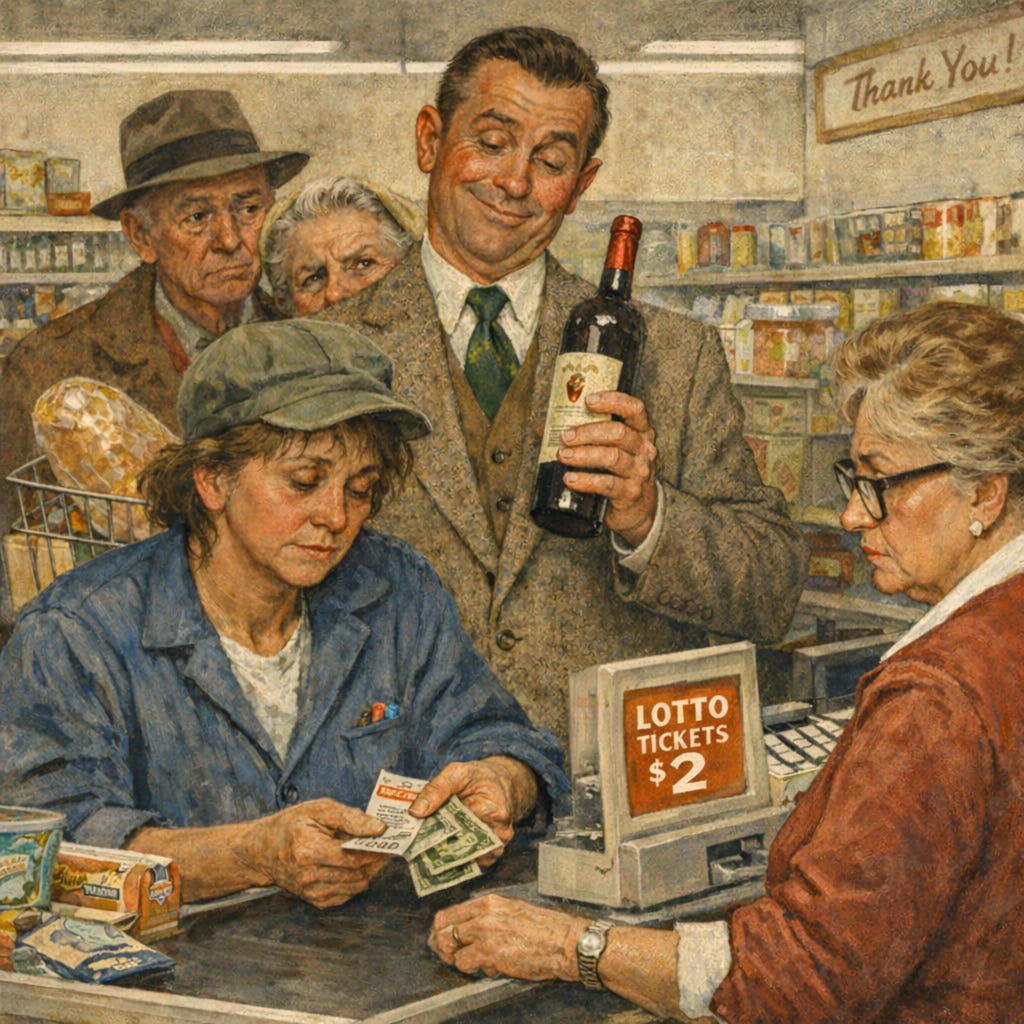
The Two Dollar Verdict
Buying a lottery ticket is, according to the consensus of every financially literate person you’ve ever met, a uniquely stupid thing to do. The expected value is negative. The odds are astronomically stacked against you. You are, mathematically speaking, barely better off than simply setting your money on fire.
And they’re right. Mathematically.
They’re also applying a standard they don’t apply to anything else, including to themselves.
Is it rational to spend $400 on a wedding dress you’ll wear once? Is it rational to pay off your mortgage early when the stock market would almost certainly deliver a better return over the same period? Is it rational to spend $15 on a cocktail that takes three minutes to drink and leaves you marginally worse at everything you do for the rest of the evening?
Nearly all of our spending is irrational. That’s normal. We call it: human. We understand, implicitly, that people spend money on feelings, on meaning, on ritual, on the small daily pleasures that make the ordinary feel like it was worth showing up for. We extend that grace to almost every purchase a person can make.
But not lottery tickets.
The Dopamine Economy
Neuroscience has known for decades what personal finance hasn’t caught up to: the anticipation of a reward activates the dopamine system more reliably than the reward itself. You don’t get the rush when you win. You get it when you might.
A two-dollar lottery ticket, purchased on a Sunday night before a Wednesday drawing, buys three days of imagining a completely different life. Not a marginally better one. A different one. Three days of deciding whether you’d quit or give notice. Whether you’d tell anyone or disappear for a while. Whether you’d buy your mother a house or just pay off her car and never say where the money came from.
Most things you buy offer a slightly better Tuesday. The lottery ticket lets you rehearse a different future entirely. That’s not a minor distinction, and it’s not irrational. It’s the cheapest form of something that people with better options get for free. It’s hope.
When The Math Actually Changes
There’s a version of the lottery ticket critique that almost works. It goes like this: if you saved that money instead, it would compound into something meaningful.
This argument is correct for a certain kind of person. If you’re making $200,000 a year and you’re buying lottery tickets instead of maxing your retirement accounts, you’re leaving real money on the table. The opportunity cost is genuine.
But nobody actually cares if a lawyer making $200,000 buys a Powerball ticket. It’s the poors we’re talking about.
And that argument is even weaker than it sounds.
If you’re earning $28,000 a year and you skip the twice-weekly lottery ticket, you save sixteen bucks a month. At the end of a year you have around $200. After a decade, with optimistic market returns, you have maybe $2,500. That’s not a down payment. That’s not a retirement. It’s not even much of an emergency fund. That’s $2,500 after ten years of discipline—a number that does not materially change the trajectory of your life in any direction after a period of time that statistically outlasted the marriage the wedding dress was meant to celebrate.
The expected-value calculation that makes lottery tickets look stupid assumes you’re someone for whom small amounts of capital compound into large amounts of capital. For tens of millions of Americans, that assumption is simply false. The alternative to the lottery ticket isn’t a comfortable retirement. It’s the same life, minus the hope.
Against the plausible alternatives, a non-zero chance at transformation looks different than it does on a spreadsheet. Not smart, exactly. But not obviously dumb either. And seven days of genuine excitement per week, fifty weeks a year1, for $16 a month—that’s a price point a lot of therapists would struggle to match, whatever your copay.
But maybe you think it’s worse than irrational. Maybe you think it’s gambling.
The Shame
The line between a stupid purchase and an addiction has nothing to do with dollars. Someone funneling their entire paycheck into scratchers has a problem—but so does someone spending $300 a week on cocaine, regardless of how big a pile they can afford. The pathology isn’t the price. It’s the compulsion. We don’t evaluate Snickers bars by their worst-case consumer. We sell them to kids.
A young lawyer passes the bar and buys a Rolex. We call that a milestone. It’s not a good investment—most watches depreciate, and the money would perform better in an index fund by almost any measure. But we understand that he’s not buying a watch. He’s buying a feeling about his future. He’s buying a signal to himself and everyone around him that something has changed, that he’s arrived somewhere, that the work paid off. We find this not just acceptable but admirable.
A woman earning fourteen bucks an hour buys a lottery ticket on her way home from a double shift. We call that a tax on the poor. A failure of financial literacy. Evidence that some people just don’t understand how money works. That maybe they actually deserve what they get.
Both of them spent money they didn’t need to spend, on a feeling they wanted to have. One of those feelings is legible to the people doing the judging. The other isn’t.
The critique of lottery tickets is dressed in the language of financial rationality. But financial rationality, applied consistently, would also indict the Rolex, the destination wedding, the brand-name interview suit, the paid-off mortgage, and every other purchase humans make for reasons that can’t be reduced to a pro forma. We apply it selectively, and the selection is not random.
It’s poor.
The Point of a Hammer
People spend money on hope. They always have. They buy candles for altars, rounds for strangers, fireworks for the Fourth of July. They splurge on the good Champagne for the occasion that deserves it. They tip more than they should when the server reminds them of their kid. None of this maximizes utility. All of it is completely human, and we don’t judge any of it—because we understand, without needing it explained, that the point of money was never the fucking money.
The point was always to build something. A life that feels like yours. A Tuesday that felt worth showing up for. A moment, however brief, of genuine excitement about what might happen next.
Most of us are just trying to buy a little hope. A little something to look forward to. There’s nothing wrong with that. There never was.
The only thing worth questioning is why we reserve our judgment for the people buying it two dollars at a time.
And hey, if that’s you, good luck.
When you’re not on vacation.